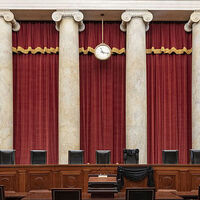



WASHINGTON (CN) - The Supreme Court did not appear convinced on Monday that Louisiana prison officials had adequate notice of the consequences they could face for shaving a Rastafarian man's dreadlocks.
"I don't think when the prison guard is hired, he says, 'Well, I want to see the federal conditions that you agreed to under the contract,'" Chief Justice John Roberts, a George W. Bush appointee, said, calling such a scenario a "legal fiction."
Under the Religious Land Use and Institutionalized Persons Act, Rastafarians like Damon Landor who maintain dreadlocks as a demonstration of their religious beliefs are exempt from prison hair standards. But two officials at Louisiana's Raymond Laborde Correctional Center shaved Landor's knee-length dreadlocks anyway.
Landor wants monetary damages from state prison guards that violated his religious rights, but a majority of the conservative justices didn't seem to think RLUIPA clearly authorized such relief.
Congress could have written a statute specifying that individual guard's liability under RLUIPA. Justice Neil Gorsuch, a Donald Trump appointee, said, "What I'm struggling with is, did it?"
In 2020, the high court unanimously held that individual federal officials could face monetary damages for violating the Religious Freedom Restoration Act, or RFRA, in Tanzin v. Tanvir. But the Supreme Court's long-running tug-of-war with Congress bound RLUIPA protections to state programs that receive federal funds.
Gorsuch and his conservative colleagues appeared to think the distinction precluded individuals like Landor from seeking monetary damages because state officers were a third party to the contract between the federal government and state programs.
Louisiana's Solicitor General Benjamin Aguinaga said the answer to the justices' question "is across the street, not here," referring to Congress.
The three liberal justices seemed incensed at the suggestion that state officials would think they wouldn't be held liable for RLUIPA violations.
"We're all presumed to know the law," Justice Sonia Sotomayor, a Barack Obama appointee, remarked.
Justice Elena Kagan, another Obama appointee, questioned how state officials could not know they'd face lawsuits for RLUIPA violations when officers routinely face claims for other constitutional violations.
Landor's attorney said Landor himself gave guards at Raymond Laborde documentation of his religious accommodations, including a Fifth Circuit opinion holding that Louisiana's policy of cutting the hair of Rastafarians violated RLUIPA.
The guard discarded the documents, according to Landor, and the prison warden refused to give him time to obtain additional documentation from his sentencing judge. Prison officials handcuffed Landor to a chair, held him down and shaved his head. He was kept in lockdown for the last three weeks of his sentence.
"The facts of this case are egregious," Justice Amy Coney Barrett, a Trump appointee, said. "So, if on the facts, we were looking for a case in which there should be money damages, this is it."
But Barrett and her conservative colleagues - who are typically sympathetic to religious plaintiffs - wanted to focus on a different set of facts. Gorsuch asked hypotheticals about federally funded universities allowing transgender athletes on women's sports teams and state agencies that provide abortions.
"I think you have to follow the logic where it leads," Barrett said, suggesting that individual coaches or doctors could face lawsuits under Gorsuch's hypothetical.
Those scenarios posed more difficult questions, Landor's attorney admitted, but he said Congress would have to pass laws barring transgender athletes from women's sports teams or prohibiting abortions first.
Trying to steer the conversation back to Landor, Zachary Tripp, an attorney with Weil, Gotshal & Manges, said, "This is an unusually easy case."
"We're not asking you to change any law on the front end about what Congress can and cannot do in the first instance," Tripp said.
Arguing in favor of Landor, the Trump administration warned that other statutes could be imperiled if the Supreme Court ruled the prison officials couldn't be held liable here.
"If the court says that ... Congress can't do this, then I think that would be ground-breaking," Libby Baird, assistant to the solicitor general at the Justice Department, said.
Justice Brett Kavanaugh, a Trump appointee, seemed to think the court could avoid that outcome with a narrow ruling.
"If we were to conclude that this statute does not clearly, unambiguously authorize damages, that avoids all the ground-breaking issues that you've been discussing," Kavanaugh said.
Source: Courthouse News Service